
“A work of thought — to go toward the other, to the absolutely other — does not come back to the same.” Emmanuel Levinas, Totality and Infinity
The philosopher between cities
I live between cities, languages, and obligations. Part of my life unfolds in Milan, part in Frankfurt an der Oder, and part, more painfully, more stubbornly, in Zaporizhzhia, a city I cannot presently inhabit except through worry, solidarity, and the refusal to let distance become moral comfort. This is not quite exile, not quite cosmopolitanism, and not quite the ordinary modern condition of mobility. It is a more demanding event: a life distributed across several sites of belonging, none of which can claim me entirely, all of which make a claim on me as my homes.
Philosophy has given us two great figures of home, and neither is enough. For Heidegger, dwelling means rootedness: to be at home is to be gathered into a place, a language, a world. For Levinas, home becomes truly human only when it opens itself to the stranger. One gives us belonging; the other, hospitality. But what happens when the one who must dwell is also the one who must keep moving? What happens when home is neither a fixed hearth nor its loss, but something composed again and again across distance, memory, intimacy, and responsibility? My claim is simple: the nomad is not the negation of home. The nomad forces us to rethink what home has been all along.
The temptation of roots
Heidegger’s most concentrated meditation on dwelling is the 1951 Darmstadt lecture, “Building Dwelling Thinking.” Its central move is etymological and devastating. The Old High German word for building, bauen, originally means to dwell. More: bauen is cognate with buan, bhu, beo — and with the verb “to be.” Ich bin, du bist do not merely signify existence in the abstract; at their root, they say: I dwell, you dwell. To be is to dwell. The entire Western metaphysical tradition, with its separation of being from habitation, is revealed as a forgetting — we have forgotten that being is dwelling, and this forgetting is the real homelessness of the modern age.
This is an extraordinary claim, and its radicalism should not be domesticated. Heidegger is not offering a sentimental theory of rootedness. He is saying that the question of home is the question of being, that homelessness is not a sociological condition but an ontological one, and that no amount of construction — no housing programme, no urban planning — will resolve it, because the crisis lies deeper than any building can reach. Dwelling, for Heidegger, takes place within what he calls the Fourfold: the gathering of earth, sky, divinities, and mortals. A bridge does not merely span a river; it creates its banks as banks, constitutes the landscape as landscape, gathers the Fourfold into a location and thereby opens a space where dwelling becomes possible. Home is not a coordinate on a map. It is a mode of being that lets a world appear.
And yet. The philosopher who thought dwelling with the greatest depth was also the philosopher most catastrophically compromised by rootedness. Heidegger’s own examples are relentlessly particular: the farmhouse in the Black Forest, the jug on the table, the specific Heimat that cannot be translated because it names a belonging that resists universality. In the “Letter on Humanism,” written four years earlier from the ruins of his own career and reputation, Heidegger declared that language is the house of Being — a magnificent formulation, but one he consistently understood in the singular. One language, one house. The thinker who insisted that homelessness must be thought as a philosophical provocation rather than a mere misfortune could not, or would not, think the dwelling of the one who lives in several languages at once, who is at home in the corridor between tongues rather than in any single chamber.
I call this the Heideggerian aporia. If dwelling is the basic character of being — if to exist is already to dwell — then the nomad, too, dwells, and Heidegger’s framework must be able to account for nomadic dwelling. But the concrete texture of his thought resists precisely this extension. The Fourfold gathers in this place, this language, this tradition. The bridge creates these banks. What gathers the existence that is dispersed across Milan, Frankfurt, and the absent presence of a city under fire? What bridge creates those banks? Heidegger does not ask the question, and the silence is not accidental. It is the limit of a philosophy of dwelling that begins in ontology and ends — against its own deepest insight — in topophilia.
The ethics of welcome
Levinas answers what Heidegger cannot. Or rather, he shifts the entire question. For Heidegger, the home gathers a world; for Levinas, the home receives a face. In Totality and Infinity, the dwelling is not primarily a relation to place but a relation to the Other — and this changes everything.
The argument unfolds in stages. First, Levinas insists that subjectivity is constituted through enjoyment. Before we are thinking subjects, we live from things — from good soup, from air, from light, from the warmth of a room. This enjoyment is not trivial; it is the primary form of selfhood, the way a being separates itself from the anonymous murmur of existence and becomes someone in particular. But enjoyment is insecure. The elements nourish and threaten in equal measure. The subject therefore constitutes a dwelling — not as shelter from the weather, though it is that too, but as the structure of recueillement, recollection, the gathering of the self into an interiority from which it can then venture outward. The home is the site where I come to myself, where I collect my thoughts and my forces, where I achieve the separateness without which I could not meet another as truly other.
So far, this sounds like a phenomenological supplement to Heidegger — interiority rather than the Fourfold, but still a philosophy of gathering. The decisive Levinasian turn comes next. The dwelling, Levinas argues, is from the start constituted by a welcome. I do not first build a house and then invite someone in; the very structure of the home presupposes a gentleness, a warmth, a receptivity that precedes my autonomous self-constitution. And then — the moment that makes Levinas Levinas — the Other arrives. The face of the stranger appears at the threshold and interrupts the economy of enjoyment, the circuit of the self with itself. The face does not ask to be understood or assimilated; it commands. The home discovers its vocation: it exists so that the Other may be received. Hospitality is not one virtue among many. It is the primary meaning of home.
In a passage that goes to the heart of my project, Levinas opposes two paradigmatic figures of the journey. Ulysses departs from Ithaca, endures his odyssey, and returns home: the circle of the Same, departing from itself only to come back to itself enriched but fundamentally unchanged. This, Levinas suggests, is the deep grammar of Western ontology — all otherness ultimately reabsorbed into the totality of the known. Against Ulysses, he sets Abraham, who leaves his fatherland forever, for a land unknown, and forbids his servant to bring even his son back to the point of departure. Abraham’s journey is irreversible. It moves toward the Other without the guarantee of return — a transcendence without nostalgia.
The opposition is magnificent, and it illuminates something real. But it also generates its own aporia — the Levinasian aporia, which mirrors and inverts the Heideggerian one. If hospitality requires a dwelling, and the dwelling requires an interiority, a threshold, a door that can be opened to the stranger, then what becomes of hospitality when the host has no single door? Levinas himself celebrated the nomadic ethos of the Judaic tradition as a corrective to Heidegger’s paganism of place. But his own phenomenology quietly presupposes a relatively settled subject: someone who has a home and opens it, not someone who is perpetually composing a home from scattered materials. The nomad, seen from within Levinas’s framework, faces an impossible choice: either settle somewhere and risk the closure of Heimat — the very thing Levinas set out to overcome — or keep moving and forfeit the interiority from which genuine welcome proceeds. Neither Ulysses nor Abraham: the nomad is a third figure that neither thinker fully imagined.
The nomadic host
What, then, is the home of the nomad? Not a place. Not the absence of place. Something else — a practice, a composition, an ethical-material labour that must be performed again and again without the assurance that it will ever be finished.
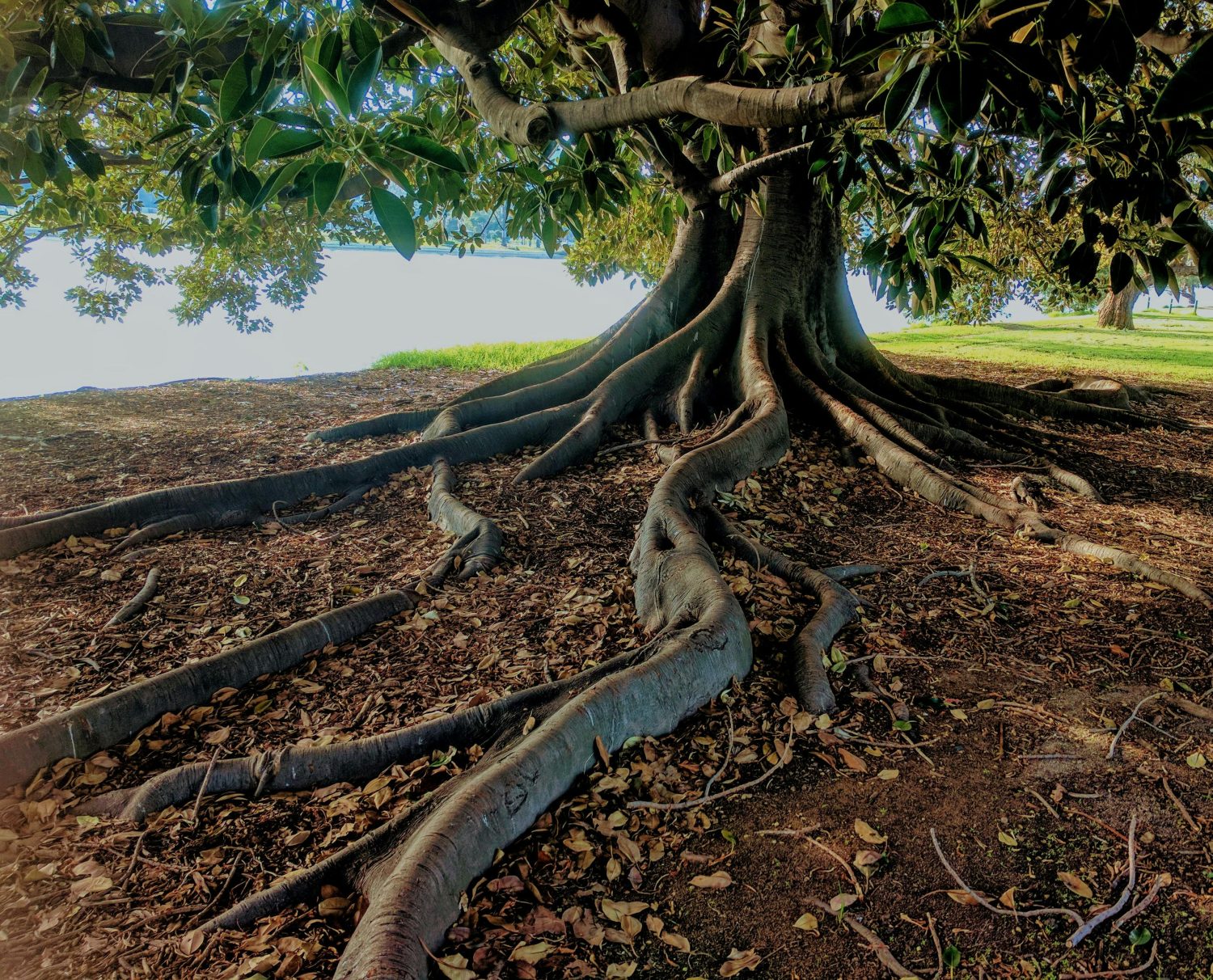
I propose the concept of polyrhizia: multiple, simultaneous, non-hierarchical rootedness. The term is deliberate. Against Entwurzelung — uprootedness, the condition that Heidegger feared and that modernity allegedly inflicts — and against the single deep root of Verwurzelung, the autochthonous belonging that Heidegger sometimes seemed to celebrate, polyrhizia names a mode of dwelling in which one is rooted in several soils at once, nourished by several traditions, gathered by several places, without any one of them claiming sovereignty over the others. The nomad is not rootless. The nomad is multiply rooted — and it is precisely this multiplicity that conventional philosophies of home cannot accommodate.
Consider, concretely, the three modalities of dwelling that constitute a nomadic existence such as mine. The first is the dwelling of intimacy: a kitchen in Milan, a particular quality of evening light on a particular street, a language spoken in its most tender register only with one person. This is the closest thing to what Levinas meant by the warmth of recueillement — the gathering of the self in the presence of the beloved. It is not a house; it is a practice of closeness that constitutes a home wherever it is enacted. The second is the dwelling of vocation: a seminar room in Frankfurt an der Oder, a library, the multilingual labour of the philosopher who writes in one language, lectures in another, and dreams — when he dreams at all — in a third. Heidegger was right that language is the house of Being; what he did not see is that this house has many rooms, and that some of us live in the corridors. The third — and this is the modality that stretches the concept of dwelling to its limit — is the dwelling of responsibility: Zaporizhzhia, a city I inhabit not by physical presence but through care, through solidarity, through the refusal to let distance become indifference. To dwell in a place you cannot reach, a place that is being destroyed while you are safe elsewhere — this is perhaps the most demanding form of home, because it receives no confirmation from the senses, no warmth from walls, no comfort from routine. It is sustained entirely by ethical commitment, by the insistence that one’s home extends beyond the perimeter of one’s body.
The figure that emerges from these three modalities is what I call the nomadic host. Neither Ulysses, who returns to the same hearth, nor Abraham, who abandons every hearth for the unknown — the nomadic host carries the capacity for hospitality across locations, composing a moveable threshold in each place of sojourn. The nomadic host does not wait for the stranger to knock at a pre-existing door; the nomadic host constitutes the door in the act of opening it. This is not homelessness aestheticized. It is a rigorous existential structure: the home as something made rather than given, composed rather than inherited, practised rather than possessed. And its deepest implication is this: if the nomad’s dwelling is not a state but a practice, then dwelling and hospitality are not competing determinations of home — as they appear to be in the tension between Heidegger and Levinas — but co-constitutive moments of a single structure. To dwell is already to be hosted, by the places and languages and persons that receive you. And to host — to open one’s provisional, portable, always-incomplete home to the Other — is already to dwell, because it is in the act of welcome that the nomad most fully comes to herself.
Translation as dwelling
If language is the house of Being, then translation is not the passage from one house to another but a form of dwelling in its own right — perhaps the form most native to the nomad. The translator does not dissolve the difference between languages; that would be the linguistic equivalent of cosmopolitan homelessness, the fantasy that all tongues are secretly one. Nor does the translator remain enclosed within a single language, which would be the linguistic equivalent of Heimat. Translation sustains the tension between worlds without collapsing it. It inhabits the interval — precisely the space I described at the start of this essay, somewhere between the Adige Valley and the Inn, between one grammar of experience and another. The multilingual subject who writes a philosophical argument in English, teaches it in German, and whispers its consequences in Italian at the end of the day is not performing three separate acts of dwelling. She is enacting polyrhizia in its most intimate medium: thought itself, moving across the roots of different languages without tearing free from any of them.
But I must not aestheticize this condition. Polyrhizia, as I have described it, is elective — a privilege of the philosopher with a passport and a university contract. There exists another polyrhizia, one that is forced: the polyrhizia of the refugee, the internally displaced person, the exile who did not choose multiplicity but had it imposed by war, by persecution, by the destruction of the singular home that was never meant to become plural. The difference between these two modes of distributed dwelling is ethically decisive, and any philosophy of nomadic home that fails to mark it risks turning displacement into a lifestyle. The nomad who reflects on dwelling from within a seminar room owes a debt of honesty to the nomad who reflects on dwelling from within a temporary shelter. What unites them, ontologically, is the structure of polyrhizia itself — the fact that a life distributed across several sites of belonging is not a deficient form of dwelling but a form of dwelling in its own right. What separates them, ethically, is everything else.
And here the question of home opens onto the question of the Earth. Can the planet itself be home? The temptation of planetary cosmopolitanism is real and must be simultaneously embraced and resisted. Embraced: because the crises of our time — war, displacement, ecological devastation — cannot be addressed from within the perimeter of any single Heimat. Resisted: because if everywhere is home, nowhere is home. Heidegger understood this. Dwelling requires nearness, specificity, the particular gathering of this place, this language, this sky. A planetary home without any specific interiority would be mere homelessness wearing a cosmopolitan mask.
The Earth, then, can be home only as what I would call a dwelling of dwellings — a finite, non-sovereign horizon that shelters the plurality of particular homes without replacing them. Not one great house but the ground, in both the geological and the philosophical sense, that makes all particular houses possible. The nomad, who moves between homes without absolutising any one of them, is in a unique position to understand this: the Earth is shared not by erasing differences but by maintaining them as the very texture of shared habitation. I call this differential universalism — the principle that what is universal is not a single form of dwelling imposed on all, but the irreducible plurality of forms of dwelling held together by the finite Earth that sustains them.
A few hours from now, I will change trains in Berlin, cross Brandenburg until the Oder, and arrive in a small university town where my name is written on a door. Tomorrow, or the day after, I will reverse the journey. This is not homelessness. It is home in its plural, unstable form: composed across intimacy and obligation, across the beloved and the endangered, across the places that shelter me and the places that still lay claim to my care. The nomad does not solve the crisis of dwelling on a finite and wounded Earth. But the nomad reveals something settled life prefers to forget: home was never simply given, never purely singular, never self-sufficient. It was always made. It was always shared. It was always, at its best, a practice of welcome.
The Author