


Every philosophy is a commentary on Plato, and so is mine. The reason for returning to this figure again and again through millennia is that there are distinctions – such as body and soul, reason and desire, knowledge and opinion – which he might not have invent himself, but arranged so well that we still live somewhere inside this arrangement. One of the Platonic moments that makes me particularly curious is psychopolitics: the idea of psychic and political life mirroring each other. Plato introduces not only a class theory of society, but also a class theory of the soul: something in me obeys, something rules, something mediates. The elements of this psychic structure, however, are not fixed, and upon a closer look they are drawn into a paradoxical motion and pass into each other. In what follows, I address the dialectic of power and desire first in Plato’s Republic and then in Phaedrus, bringing it into a dialogue with Freud’s theory of the psychic apparatus and Alexandra Kollontai’s communist politics of sexuality.[i]
To begin with, let me recall that main question of Plato’s Republic is: “What is justice?” Plato discusses it in the context of the city and the ways how best to govern it. At the origin of political communities, according to Plato, there is an insufficiency of separate individuals: we are not able to provide for all our needs by ourselves, and therefore have to coordinate with others: “As a result of this, then, one man calling in another for one service and another for another, we, being in need of many things, gather many into one place of abode as associates and helpers, and to this dwelling together we give the name city or state (πόλις)” (Republic, 369c). Justice depends upon the right social stratification and the distribution of labor, wherein everybody is doing their own work. Foreshadowing modern class theory, Plato suggests to distinguish between three different classes.
The largest is the class of producers of all kinds, who provide for various needs: peasants for food, builders for housing, doctors for medical care, and so on. These people want to prosper and live their lives “in peace and health,” eat nice food, have families, enjoy sex with each other and raise offspring, to whom they “hand on a like life” (372a-d). Although those are exactly the people who keep the economy going, Socrates and his interlocutor Glaucon describe them in a rather arrogant and patronizing manner and compare to working animals that have to be well fed and carefully shepherded. This category is also joined by intelligentsia, service workers and other residents.
As the city grows, so do the needs of the people, and the number of produces and the commodities and services they produce diversifies until the point when economic growth leads them into the state of war, the origin of which lies in the desire to seize the land of their neighbors or to defend their own land from the neighboring communities that want to seize it. Hence, the need for a separate class of guardians (φύλακες), whose job is to defend the city and ensure that its citizens can keep living in peace and doing their own businesses. Free of other obligations, the guardians form a professional army. The guardians must be courageous, but at the same time gentle, as their task is to secure the life of the community and to be ready to fearlessly oppose everything that threatens to endanger it. Here, too, an animal metaphor is applied – this time, of a pedigree dog: “most gentle to their familiars and those whom they recognize, but the contrary to those whom they do not know” (475e). Like a shepherd dog, he watches over the herd, while himself obeys his master.
Finally, there is a class of exceptionally smart and perfectly educated men who know how to govern the city – the ruling class, as it were, the shepherds who guide both the army of dogs and the herd of the people. This group is the smallest, and, as it is stated in the dialogue, the best. Such an evaluation is based on Plato’s belief in the moral superiority of intellectuals, who are capable of reflection and contemplation. What distinguishes them from the rest of citizens is wisdom (σοφία). Devoted to truth, they simply cannot be malicious, and are therefore competent to take political decisions. Rather than being specialists in some particular matters, they possess the knowledge allowing them to judge about the city as a whole.
Plato’s ideal city must be wise, courageous, moderate, and just (427e). Moderation refers to “a kind of beautiful order and a continence of certain pleasures and appetites” (430e). Socrates also calls it a “master of himself” (κρείττω αὑτοῦ) and notices that there is something ridiculous about it: “For he who is master of himself would also be subject to himself, and he who is subject to himself would be master. For the same person is spoken of in all these expressions” (430e-431). A moderate city is the one in which social hierarchy appears as a perfect harmony and balance between the rulers and the ruled. Justice encompasses the entire social system and consists in doing one’s own thing: producers produce, guardians guard, and rulers rule, without getting in each other’s way.
This is indeed an utterly undemocratic political project, the critique of which has long been a commonplace, to say the least. However, contributing to this line of critique is not my goal. What I want to highlight is something else – namely, the dimension of psychopolitics, which Plato reveals in outlining his political anthropology through the general model of the ideal city. I call “psychopolitics” the theory of a correlation between political and psychic structures. The logic of Socrates’ argument is the following: first we analyze what is bigger and easier to analyze – a city – and then apply the same conceptual framework to what is smaller – a citizen, for there must be a structural homology between the two.
The psycho-political knot tied by Plato is so tight that at places it is unclear whether Socrates is talking about the soul or about the city. Indeed, Plato doesn’t explicitly equate, but rather compares them, and yet I suggest to pay more attention to the formula read between the lines of the Republic: the soul is not one; it is a πόλις, a political community, and vice versa – a political community has a psychic structure. Bracketing the comparison, the soul is a city. Through this formula, Plato comes up with nothing less than the class theory of the embodied soul, which, similarly to the city, comprises at least three parts corresponding to the three social classes (441c-e).
Plato’s psychopolitics runs through the body, dividing it into parts according to the given class stratification. The appetitive part of the soul, ἐπιθυμητικός (from ἐπιθυμία – desire), is located in the stomach. It lusts, hungers, thirsts and seeks bodily pleasures. The spirited part, θυμοειδές (from θυμός – spirit, breath), located in the chest, is the one “with which we feel anger” or have other affects and emotions. The rational part, λογιστικός (from λόγος – account, speech, law, rule, principle, etc.), located in the head, is responsible for reasoning and calculation (339-441). Accordingly, the appetitive part is compared to ordinary citizens, who simply live their lives pursuing their natural desires, the spirited part to courageous guardians and warriors, who defend the city as a whole from external and internal threats, and the rational part to the wise minority of the rulers who smartly guide the others.
One can say that, in a sense, ἐπιθυμία and θυμός manifest two kinds of energy – the first one is rather positive and (re)productive, the second one negative and even destructive, but its destructive force is used for good purposes: in the soul, just like in the city, there are militaries protecting civilians, whereas λόγος gives a sense of balance and navigation. Note that the Greek word for the republic, πολιτεία, also translates as government, administration, constitution, and so on. Related to the political organization of a community life, the πολιτεία of the soul works through the tension between desire and power.
I sit on a couch and look out of the window: what a beautiful sunset! The appetitive part of my soul fantasizes about going for a walk, along this romantic promenade, and not just a walk, but making love to that person, and then again, to infinity. But the rational part calculates: no, this is not what I must think about right now – and sends the army of guardians to repress my desires. The courageous dog of my heart barks: “You are a philosopher, Oxana, and the only love you can feel is the love for wisdom, woof, woof.” I know, it’s ridiculous, but I have to obey them and master myself: κρείττω αὑτοῦ. Why? Because I must be just, and justice consists in doing my own thing, which is, at the moment, reading Plato and writing these lines.
With a Plato like that, you would not even need Freud, whose theory of the psychic apparatus as an interaction of the three agencies – id, ego, and super-ego – seems to be so accurately prefigured by the psycho-political struggles outlined in the Republic. Let’s imagine that the Freudian id (instinctual desires) correlates to the appetitive part of the soul, the super-ego (critical and moral agency) to the rational one, while the role of the ego (the instance of rationality and common sense) – mediating between the super-ego and the id – is similar to the role played by the spirited guardian of the soul. The ego is a sort of a guardian, too, but instead of looking after the flocks of desire, it converts their manifestations into a decent content according to the requirements posed by the higher authority of the super-ego. A security officer rather than a shepherd dog, a policeman rather than a warrior, the ego might not need much courage to censor the soul. But, still, to control the turbulence of bodily desires is not an easy task. Freud’s metaphor for the ego in its relation to the id is “a man on horseback, who has to hold in check the superior strength of the horse,”[ii] and often the rider “is obliged to guide it where it wants to go; so in the same way the ego is in the habit of transforming the id‘s will into action as if it were its own.”[iii] The rider of my soul can use the horsepower of its passions to travel in any direction, for better or for worse.
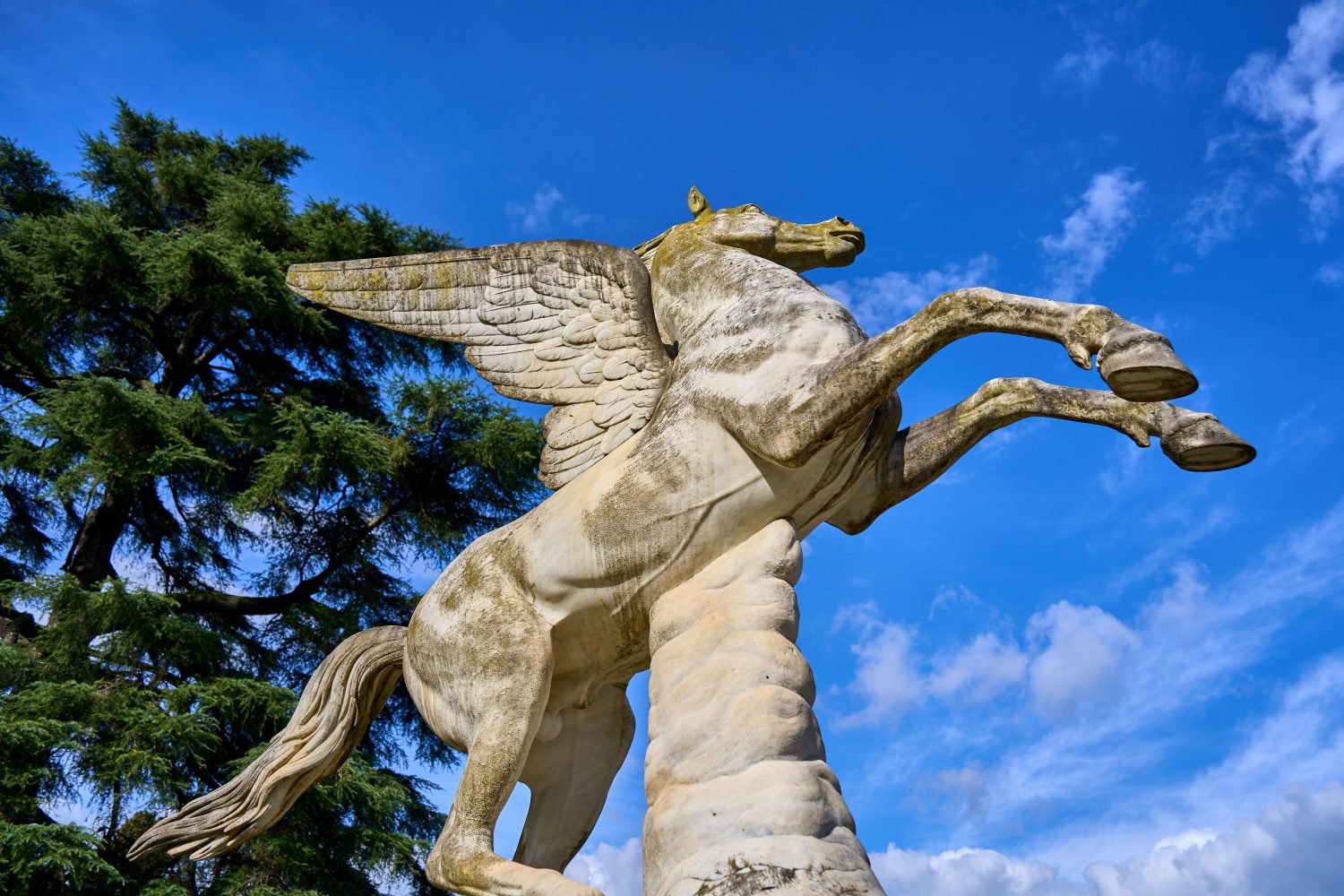
Meanwhile, Plato’s soul is also complicit with horses. In Phaedrus, his dialogue on love, it is compared to a chariot with a charioteer driving a pair of winged horses. One of these animals is white, good, beautiful, and with its strong wings rushing up to the heavens; the other is black, bad and heavy, and pulling down to the ground (Phaedrus, 246b; 253d-e).[iv] The theme of the dialogue is erotic love as a deadly psychic conflict. Why do we love beautiful boys? Because, according to Plato, they remind us of Beauty itself, which is not a material thing, but an eternal idea. It is Beauty itself that shines through the looks of attractive people. But erotic desire aroused by these people literally makes us mad:
“Now whenever the charioteer, seeing the light of his love, having sent warmth through his whole soul through his perception, is filled with a tickling and the goads of longing, one of the horses, obedient to the charioteer because constrained then as ever by its sense of respect, holds itself in check from leaping on the loved one, but the other is no longer compliant with the charioteer’s goads or whip, but leaping, it surges violently ahead, and giving its yoke fellow and charioteer every kind of difficulty, forces them to go toward his loved one and give a reminder of the pleasure of sex” (253e-254a).
The appetitive black horse tends to get out of control and pulls the whole team into a vortex of erotic addiction: we enjoy when our boy is present and suffer when he is absent. Driven mad by mortal beauty, the horse of eros loses its wings. But those who can love philosophically, that is, remaining faithful to the Idea, do not let themselves to be deceived by lust. Obeying the voice of λόγος, their white horse grows powerful wings and races toward the gods. Their beautiful boys, too, are invited to take the path of philosophy instead of indulging in sensual pleasures, and thus those in love and the beloved ones together become the lovers of truth.
I go out and tell this story to beautiful boys. They are not convinced – for they cannot see the eternal Beauty itself that shines through their eyes. But I can. At the sight of it, I hold the horses. The task seems clear until I realize that Plato’s logos with its flashbacks of desire is actually more obscure than eros. I say that logos is obscure, because, as Plato states in his other dialogue, Phaedo, there are the remembrances which our soul brings from the underworld, where it returns after the death of the body, and where it awaits a new life in a new body. Eternal ideas such as Beauty itself, come from the afterlife. We imagine that logos, the ruling class of the soul, looks somewhere up to heavens, but its contents are actually brought from Hades that is located deep in the underground. This does not deny its heavenly orientation: heaven and abyss, up and down simply mirror each other, and the philosopher’s desire is suspended in the corridor of infinity between these two mirrors. I remember, when I was little, someone told me that heroin is better than sex. When I grew up, I quit all my addictions, except one: when I cannot do philosophy, my soul becomes so black and heavy that I can hardly walk.
Believe me or not, but Plato’s next incarnation was a woman. Born in St. Petersburg in 1872, Alexandra Kollontai became a revolutionary and a part of Lenin’s government in 1917—1918. The brightest intellectual and writer, diplomat and politician, she largely contributed to the tradition of Marxist feminism with her great essays on the politics of sexuality and love. One of these essays is entitled “Make Way for Winged Eros: A Letter to Working Youth.” Outlining a brief political history of love, she contextualizes it through different social formations – blood relations in a kinship community; love-friendship in antiquity; courtly love in a feudal system; bourgeois marriage, adultery and prostitution in capitalism; and, finally, love-comradeship among working-class people in socialism. Proletarian love-comradeship is the manifestation of sexual revolution. Free of moral, religious, and economic restrictions, it overcomes the relations of property and individualism. Sexuality becomes a collective affair. But even such comradeship is not the last historical form of love. Another form, according to Kollontai, is yet to come with the global triumph of communism. Kollontai gives it a name — Winged Eros, in contrast to a wingless one (sexual love as we know it) – and addresses it in the following way:
“In the new and collective society, where interpersonal relations develop against a background of joyful unity and comradeship, Eros will occupy an honorable place as an emotional experience multiplying human happiness. What will be the nature of this transformed Eros? Not even the boldest fantasy is capable of providing the answer to this question. But one thing is clear: the stronger the intellectual and emotional bonds of the new humanity, the less the room for love in the present sense of the word.”[v]
There is reason to believe that Kollontai’s winged eros is akin to Platonic love in a sense that it promises the joys of spiritual elevation (i.e. sublimation) that is above sexuality. The difference is that, in Kollontai, love is between not two, but many. It demands excessive energy which she calls “love potential,” a sort of generosity in emotional engagement with other people. I tell this new story to the beautiful boys, but they look even more perplexed. To Kollontai’s promise that in the future communist society “men and women will strive to express their love not only in kisses and embraces but in joint creativity and activity,” they reply that communism will never happen. The utterly reactionary times in which we live – the darkness of late capitalism gradually turning into fascism and war of all against all, against the backdrop of climate catastrophe and mass extinction – is nothing at all like the utopia drawn by the Soviet feminist in 1923. It seems that in our society there is no room for winged love. And yet, from Plato to Freud and Kollontai, there is an immemorial truth: all horses do have wings; we just cannot see them.
Notes:
[i] For a more detailed reading of Plato see my book On the Soul: Notes from the Platonic Underground, published in Danish as Om sjælen: Optegnelser fra den platonske undergrund, trans. Tom Havemann (Forlaget Mindspace, 2026). English edition is forthcoming.
[ii] Sigmund Freud, The Standard Edition, Vol. XIX, 25.
[iii] Ibid.
[iv] I use the following translation: Plato, Lysis, Symposium, Phaedrus, trans. Chris Emlyn-Jones and William Preddy (Harvard University Press, 2022).
[v] Alexandra Kollontai, Selected Writings, trans. by Alix Holt (London: Allison and Busby, 1977, 292).
The Author

You Might Also Like

