


We should stop calling them climate deniers.
Because they’re not denying it; if they denied anthropogenic climate change, they wouldn’t be acting so feverishly to shut-up, actively reject, and blow a smokescreen across our common sense. As our collective sense-making method for the natural world, scientific research into the changing signs of our environment, the wholesale pollution of every last nook and cranny we attempt to monetize, tells us an unambiguous pattern, which groups like the International Program on Climate Change keep revising to increasingly dire outcomes, demonstrating science’s historical conservativism to a fault. Instead of accepting the need for a reckoning, climate deniers accept climate science wholesale – yet are so scared of the natural consequences following the resulting logic that they actively disavow the phenomena. Those who stand to lose their monopolies on power such reckonings would bring, religiously reject the existence or mere mention of ecological destruction, revealing themselves to be the real climate snowflakes.
The fragile ego of denialism, the field of agnotology suggests, is akin to the response from telling someone that they are hurting others that they get so offended, they instead turn around and suggest that by merely pointing out that fact, that you are the perpetrator. To point out the harms of global capitalism is perceived as a direct attack on all those who identify with the power structures perpetrating these environmental harms. This psychological defense mechanism stemming from over-identification with an object or status isn’t natural, per se, but has been inculcated, imbricated for centuries with nationalism, religion, and our entire metaphysics of progress. Precisely because over-identification tends towards reaction formation, flipping the critique back on the messenger to deny its validity, that unpalatable frames are required, orthogonal to the trained counter-attacks of denialism. One manner of dealing with identity-protective cognition and structures which defend damaged subjectivities and metabolize all opposition through Schopenhauer’s classic stage theory of truth (ignore, ridicule, assimilate), is through challenging the very logic of ‘more and more and more’[i] necessary for power accumulation, trickle-down economics, and the legitimation of greed, is the poison pill of degrowth, which cannot be swallowed and metabolized by wetiko-like megamachines.[ii]
Disavowal as the conscious manifestation of the unconscious defense-mechanism of fossil capitalism identity threat is a form of ignorance-generation, or agnotology.[iii] One knows about the problem, and not only actively rejects it as an inconvenient truth, but demonizes the fact to the degree that others espousing those claims must be actively stopped. Such massive investment into denial is not a hobby; it does not come for free. Instead, entire war chests are mobilized to change the Overton window towards making climate and science denialism the norm.[iv] Such norm-creep previously occurred organically. For some time, norms have been engineered through astroturf populism, funded by those unaware of their own driving ideologies of possessive individualism and exclusionary narcissism.
The problem with serial trespass of social and scientific givens, however, is that it tips the game into another state. Just like ecosystems, when pushed hard enough fall into new stable equilibria (e.g., the Amazon changing from a tropical rainforest to a savannah), so too social systems based on certain rules can flip into different resting points. Whereas previously, trust and respect were garnered through promises of adhering to decorum, in times of high distrust, authoritarians have gained power through their anti-authority rhetoric based not on science or truth or stability, but on upsetting the entire system. In such social games, which I believe we are now in, bombast and truth by declaration rather than verification reign. To use the Dunning-Kruger model of beginner overconfidence and expert self-effacement, the winning formula is now to climb the peak of ‘Mount Stupid’ where the most confidence and the least competence will outperform high competence but lower confidence.
This is echoed in the Bullshit Asymmetry Principle (as articulated by the Italian software developer Alberto Brandolini in 2013), which states that “the amount of energy needed to refute bullshit is an order of magnitude bigger than that needed to produce it.” Or, as Jonathan Swift put it in 1710, “Falsehood flies, and truth comes limping after it.” In such an operational space, once a sticky meme overcomes the painstakingly constructed consensus reality the scientific method wrought, it is very hard to go on as before. No amount of fact-checking or schoolmarming about distinctions so passé as truth versus lies, fact-versus-fiction can do any of the work necessary to curb the proliferation of lies, which flood polite society to the point of paralyzation. Once hyperbolic lie (the Big Lie about climate or anything) has been let out of the bag, structurally a race-to-the-bottom becomes the only strategy that has any effect on the system. Louder, more violent action wins. Gangster capitalism makes it so that the way to survive in such a system is to mirror it, variously. Only extremely tightly coordinated counteraction can prevent aggrandizing riffs on hyperbolic claims from being the only game in town. And right now, that coordination and cooperation amongst the opposition is sorely lacking.
In The Collapse of Complex Societies, Joseph Tainter painted an almost inexorable picture of how power agglomeration implodes on itself. At its peak, Rome had to mine half a ton of silver a day just to pay its 120,000 mercenaries, and because they had to be able to have stuff to spend it on something, taxes had to be paid in silver.[v] Max Weber in 1906 already knew that our temporary democratic veneers grafted onto still existing oligarchies were only sustainable through continued colonization, but lamented then that there was no new material conquest available at our disposal.[vi] The Bretton Woods post-WWII agreement sought to placate internecine violence via intensifying industrial rapaciousness on nature, once empire had squeezed all it could out of non-western people through traditional colonialism (which of course continues).
Now, the clown show has reached peak stupid, peak disavowal of responsibility, to keep the house-of-cards of violence-based inequality from collapsing. Made-up metrics, hallucinated science, and facts by proclamation are tools of the trade to prolong evading the truth that everything the media circus amplifies is just another distraction from accountability. Whether it is the tragic irony of Israel reenacting the traumas their ancestors bore by imitating their aggressors, the collective Eeyore forlornness of Europe’s learned helplessness and capitulation to precision-orchestrated US think-tank distributed denial-of-service (DDoS) cultural attacks, or the great deskilling which has allowed democracies to crumble under technofeudal fascism, the abject lack of solidarity and commensurate surge in chronic and mental diseases is right on track.
The more seriously we take the establishment media circus and its favorite fodder, the less we actually put on our boots and act. Sometimes called predictive programming, it is more like a mediated hiccup of collective anxiety, a pseudo-cathartic spectacle that substitutes the appearance of processing trauma for real reckoning.
The fascination surrounding Luigi Mangioni attests to the neutralization of the potentially emancipatory moment. The desires of billionaires and paper-pushing Eichmanns to eclipse his import, play down the principled action of harm reduction he engaged in, and cling to empty values of prudish nonviolence never applied to the victims of global capitalism, belies the act’s testament that fascists do not, and should not, have a monopoly on violence.
If capital indexes with the amount of damage we do to the earth, and hence to each other, one way to give the slip to the current rationalizations for armament and arms races we currently witness militarily and technologically (insofar as the two can be disambiguated) is to acknowledge the logic of preferring assassinations over wars, especially of those who would cause them. Philosophically, from every single discipline, including that odious one of utilitarianism, the logic is flawless. If all billionaires and CEOs of transnationals had to receive to their own person the amount of damage they had done to others, most if not all would probably perish. Under capitalism, inequality is the one thing we’re not allowed to talk about. Whether it is the asymmetries between Gazan people and the IDF, limitarianism (the idea that we need to have a maximum wealth cap, preferably along the 1970s Nordic 3:1 ratio of richest to poorest, before the Mont Pelerín society engineered an ideological coup d’etat), or our destruction of the earth met with the false bandaids of cover-up CSR and SDGs — the culture industry of PR, lobbying, marketing, and consulting know how to install blind spots in our cultural imagination, and enforce them on pain of ridicule (or worse, now, at least, with the censorship installed in the United States). If leaders and competitive CEOs want to take each other out, perhaps such realpolitik comes with the position; but the ersatz sacrifice of peoples so that others can make money off of war needs to come to a grinding halt.
To be clear, the empire is already falling. All of this last gasp politics of ultimate extraction, of blood sacrifices in the holy lands, satanic vows to deep-sea mine, clear-cut, and confidence-game the economy and international relations into one more supercycle of lambos for everyone, is a sure sign that there are too many plates in the air to keep spinning. As too many indigenous peoples know: the apocalypse has already happened; it just hasn’t reached here yet. In this collapse, the questions remain: How much of our beautiful reality will it take down with it? How many species of dolphin and whale and uncharismatic microflora, fauna, and microbes that sustain our ecosystems and our lives will be taken out by the blackholes of human beings which we have allowed to become the cult leaders syphoning off our life? How much will AI bots disguised as glamor queens and hyperbolic bloviators vampirize our psychic and physical reality before we say basta?
Where are the well-organized ones, pooling their skills, to underthrow the rug of this decrepit Ponzi scheme? Where are the connectors, the hackers, the benevolent ninjas – all those we were told to look up to in our fairytales as children – who can unstick their heads from their own worry-holes to become heroes in the epic demolishing of the most dangerous epoch of systemically perpetuated insanity and ignorance to date? Where are the boring but confident stans who know how to organize for the planet? The K-pop demon hunters that actually go out and hunt the really possessed demons? The gatekeepers and archivists that suddenly make vast resources free and available? The eccentric artists, bold queers that defend who they care about, including the more-than-human world? And most of all, those who can organize and coalition-build among them, to ensure that were aligning our efforts instead of stymying them due to what Freud critiqued as the ‘narcissism of minor differences’?
These are my family, my kin, my interspecies, labelless conspirators, which I wish to breathe freely with, together, in the silence as we permaculture the rubble.
Notes:
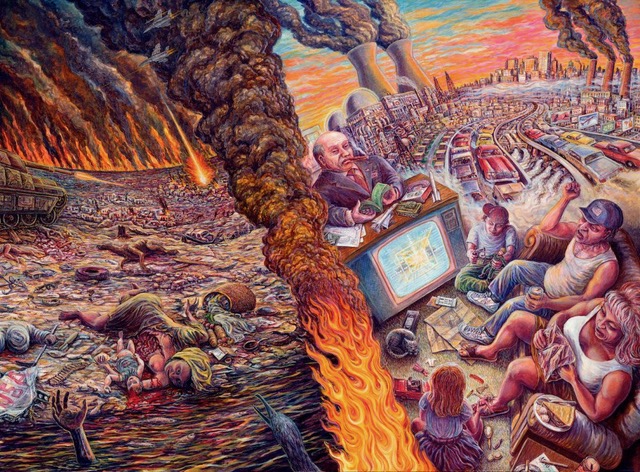
Image: “Land of the free, Home of the brave.” Oil on canvas. Mark Henson. www.Markhensonart.com Image used with permission of the artist.
[i] Fressoz, Jean-Baptiste. 2024. More and more and more: an all-consuming history of energy. London: Allen Lane.
[ii] The concept of the wetiko or windigo present in Algonquian-speaking Native American peoples is one of endless hunger. Originally the concept came out of the long winters that native peoples had to endure, the pathologies that could develop if one was not in good company that could ward off the darker specter of cannibalism that might come to mind or practice in dire times. Jack Forbes’ Columbus and Other Cannibals, and more recently Robin Wall Kimmerer’s Braiding Sweetgrass have anchored these ancient concepts in the perceptions of colonialism in all its forms, and the tendency for colonialism to never achieve satiety, or steady-state economies that allow sustainability for all its members (human and more-than-human). The concept of the ‘megamachine’ is originally from environmental historian Lewis Mumford, more recently taken up by Fabian Scheidler’s The End of the Megamachine to describe the ineluctable intertwining between industry and state power.
[iii] For essential reading on agnotology, the systemic perpetuation of ignorance, see: Proctor, Robert, and Londa L. Schiebinger, ed. 2025. Ignorance unmasked: essays in the new science of agnotology. Stanford, California: Stanford University Press and Proctor, Robert, and Londa L. Schiebinger. 2008. Agnotology: The making and unmaking of ignorance. Stanford, Calif.: Stanford University Press. For how fossil fuels inflect our identifications, see: Schmelzer, Matthias, and Melissa Büttner. 2024. Fossil mentalities: How fossil fuels have shaped social imaginaries. Geoforum 150: 103981. https://doi.org/10.1016/j.geoforum.2024.103981.
[iv] Keep in mind that Joseph Overton, for which the said window was eponymously named, worked for Dow Chemical and the Mackinac Center for Public Policy, a right-wing thinktank.
[v] See: Scheidler, Fabian. 2020. The End of the megamachine. Ridgefield, CT: Zero Books, p. 50.
[vi] Weber, Max. 1906. From Max Weber: Essays in Sociology. Translated by H.H. Gerth and C. Wright Mills. London: Routledge, pp. 71-2. This is in no way to substantiate ‘veneer theory’ – Oswald Spengler’s notion that Western civilization is a thin veneer over which a Hobbesian world would otherwise run wild. In fact, primatologist Frans de Waal, who coined the phrase, vigorously critiques this idea, arguing instead that prosocial behaviors, empathy, and cooperation are deeply rooted in our evolutionary history, not just a superficial overlay. If anything, if we follow Davids Wengrove and Graber in their The Dawn of Everything, the ‘veneer’ imposed on human nature is that of our violent, hierarchical way of being, which needs to be overthrown. At the very least, we can parsimoniously agree with the work of Anthony Kwame Appiah’s situationism, which discredits the notion that we have ‘character’ at all; and instead are a product of our environments and affordances. Hence, not letting dark triad-addicted people capture our media, government, and businesses might be a good idea.
The Author


